ANNOUNCING THE 2027
OHIO LIGHT OPERA FESTIVAL SEASON
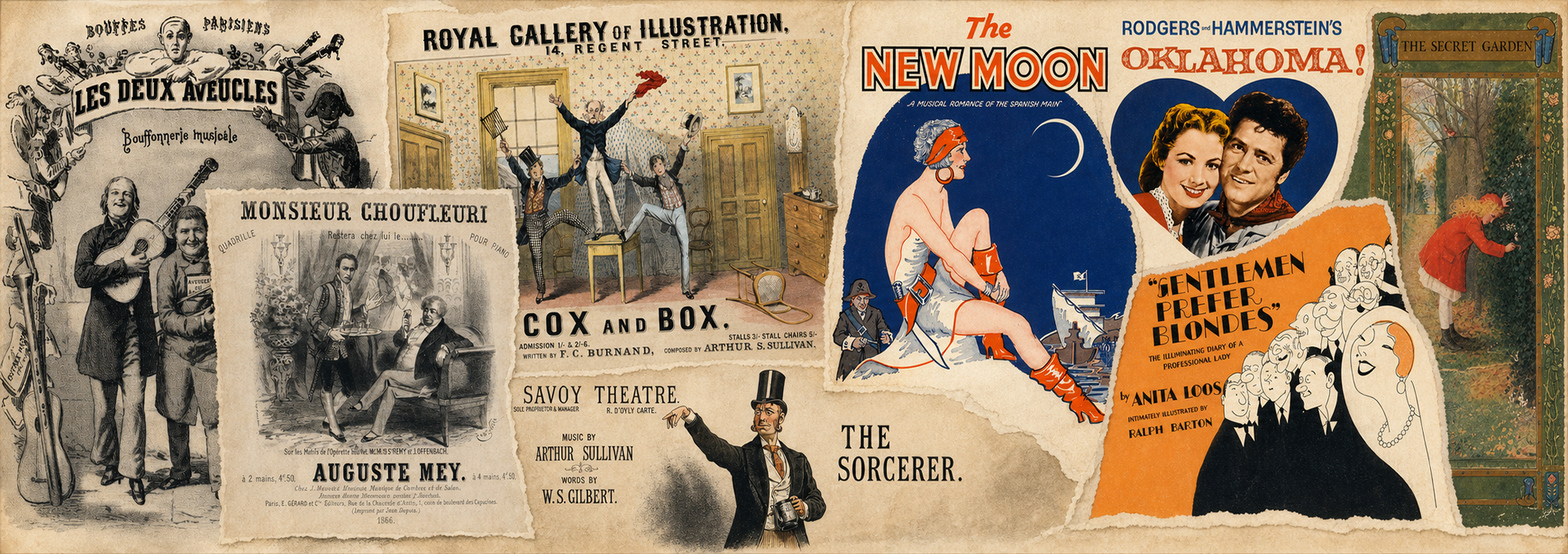
With its 2027 Summer Festival season, the Ohio Light Opera celebrates more than a century of musical theater invention—from the intimate Parisian satires that helped launch the operetta tradition to landmark works of Broadway’s Golden Age and one of the most hauntingly beautiful musicals of the modern stage. Across these six programs and eight works, false identities, secret gardens, social ambitions, revolutionary passions, magical love potions, and romantic misunderstandings abound. A pair of fraudulent beggars battle for the best location in Paris; aspiring socialites impersonate celebrated opera singers; two men unknowingly share the same room; an entire English village falls in love with the wrong people; and determined young women named Marianne, Laurey, Lorelei, and Mary struggle to shape their own futures.
The season brings together the irrepressible theatrical worlds of Jacques Offenbach, Arthur Sullivan, W.S. Gilbert, Sigmund Romberg, Rodgers and Hammerstein, Jule Styne, Leo Robin, Lucy Simon, and Marsha Norman. Some titles are treasured favorites; others are rarely given the opportunity to sparkle before today’s audiences. All will be presented with the musical vitality, theatrical care, and respect for their original traditions that have long defined the Ohio Light Opera Festival.
OFFENBACH DOUBLE BILL
TWO BLIND MEN
(Les Deux Aveugles)
(1855)
Music by Jacques Offenbach
Libretto by Jules Moinaux
English Version by Jacob Allen
The work that helped start it all! When Jacques Offenbach opened his Théâtre des Bouffes-Parisiens in 1855, Les Deux Aveugles was among the works that announced the arrival of a fresh, irreverent, and unmistakably Parisian form of musical theater. Its success helped establish both Offenbach’s new theater and the comic style that would eventually sweep across Europe and influence generations of operetta composers.
On a bridge in Paris, two supposedly blind musicians, Patachon and Giraffier, compete for the most profitable begging location. Each regards the other as an unwelcome threat to business, and each invents increasingly elaborate tales of hardship in an effort to claim the sympathies—and coins—of passing pedestrians. There is only one difficulty: neither man is actually blind. Their efforts to expose one another without revealing their own deception escalate into a hilariously shameless contest of music, manipulation, and professional rivalry. With only two principal characters, Offenbach and librettist Jules Moinaux created a miniature comic masterpiece whose pointed social satire remains as recognizable today as it was to Parisian audiences in 1855.
REGRETS ONLY
(M. Choufleuri restera chez lui le…)
(1861)
Music by Jacques Offenbach
Original Libretto by M. de St. Rémy
English Version by James Stuart
No social occasion is complete without music—and no social climber’s reputation can survive a disastrous party. A wealthy and culturally ambitious host has arranged an elegant private concert featuring three celebrated Italian opera stars. The invitations have been sent, fashionable society is on its way, and an evening of artistic triumph seems assured. Then word arrives that the singers will not appear.
Cancellation is unthinkable. With the guests already assembling, the host, his daughter, and her musically gifted sweetheart take the stage themselves, impersonating the missing celebrities and attempting to pass off their hastily assembled performance as an evening of international operatic brilliance. Their increasingly desperate masquerade gives Offenbach ample opportunity to parody grand opera, fashionable pretension, and the lengths to which people will go to impress their neighbors.
Originally titled M. Choufleuri restera chez lui le…—“Mr. Choufleuri Will Be at Home On…”—the work was first performed privately in Paris in May 1861 and publicly at the Bouffes-Parisiens that September. OLO audiences will encounter it under the witty English title Regrets Only, in the version previously presented by the company and revised by James Stuart.
Together, Two Blind Men and Regrets Only reveal Offenbach at his most concentrated and mischievous: two pocket-sized theatrical gems in which vanity, deception, social aspiration, and glorious music collide.
COX AND BOX / THE SORCERER
COX AND BOX, Curtain Warmer to The Sorcerer
(1866)
Music by Arthur Sullivan
Libretto by F. C. Burnand
Based on John Maddison Morton’s farce Box and Cox
Long before Arthur Sullivan joined William Gilbert in creating the Savoy operas, he collaborated with humorist F. C. Burnand on this ingenious “triumviretta.” Sergeant Bouncer has discovered a highly profitable arrangement: he rents the same room to two different tenants. Cox, a hatter, occupies it at night and works during the day; Box, a printer, works at night and occupies it during the day. Since each believes the other’s belongings belong to the landlord, Bouncer’s deception proceeds smoothly—until an unexpected holiday brings both tenants home at once.
The resulting confrontation over beds, bacon, and domestic territory takes an even more extraordinary turn when Cox and Box discover that they have both been romantically entangled with the same woman, the formidable Penelope Ann. A final revelation transforms rivals into something altogether unexpected. Sullivan’s buoyant score elevates Burnand’s farcical clockwork into one of the most enduring one-act works of Victorian musical theater.
Originally performed privately in 1866 and introduced to the public in 1867, Cox and Box serves as the perfect curtain warmer for the full-length Gilbert and Sullivan enchantment that follows.
THE SORCERER
(1877)
Music by Arthur Sullivan
Libretto by William Gilbert
Young Alexis Pointdextre has a theory: love alone should determine marriage, without interference from social rank, wealth, age, or circumstance. To prove it, he hires John Wellington Wells—of J. W. Wells & Co., Family Sorcerers—to brew a powerful love potion. Once slipped into the tea served at Alexis and Aline’s engagement celebration, it will cause everyone who drinks it to fall hopelessly in love with the first person they see upon awakening.
The potion works perfectly. Unfortunately, its victims awaken beside entirely unsuitable partners. Elderly aristocrats pursue youthful villagers, the village notary becomes infatuated with the pew-opener, and romantic chaos engulfs Ploverleigh. Even Alexis’ beloved Aline, initially reluctant to drink the potion, eventually succumbs and awakens to declare her devotion—not to Alexis, but to the melancholy vicar, Dr. Daly. Only Wells can undo the spell, but reversing the enchantment will demand a considerable sacrifice from the sorcerer himself.
The first full-length work created by Gilbert, Sullivan, and producer Richard D’Oyly Carte, The Sorcerer introduced many of the ingredients that would define their later masterpieces: mismatched lovers, topsy-turvy social hierarchies, a dexterous patter role, an active chorus, and music that treats even the most absurd situations with complete melodic sincerity. Its score includes Wells’ dazzling entrance, “My Name Is John Wellington Wells,” Dr. Daly’s wistful “Time Was, When Love and I Were Well Acquainted,” and the sublime ensemble “I Rejoice That It’s Decided.”
THE NEW MOON
(1928)
Music by Sigmund Romberg
Lyrics by Oscar Hammerstein II
Book by Oscar Hammerstein II, Frank Mandel, and Laurence Schwab
Sigmund Romberg’s last great Broadway operetta combines revolution, romance, adventure, and one of the most glorious scores ever written for the American musical stage. Robert Misson, a young French aristocrat with revolutionary sympathies, has fled his homeland and entered service as a bondservant in New Orleans. He falls in love with Marianne Beaunoir, the spirited daughter of his employer, but conceals both his noble birth and the political activities that forced him into exile.
When the authorities discover Robert’s identity, he is placed aboard the ship The New Moon for deportation to France. Marianne follows, believing that Robert has betrayed her affections, only to find herself swept into a mutiny led by the ship’s bondservants. Cast ashore on a tropical island, the rebels establish a new republic, but their freedom is threatened when French forces arrive. Before Robert and Marianne can find happiness, both must overcome pride, political danger, and seemingly irreconcilable misunderstandings.
Opening on Broadway in September 1928, The New Moon was one of the final major triumphs of the great American operetta tradition. Its extraordinary score offers melody after melody: “Marianne,” “Softly, as in a Morning Sunrise,” “Wanting You,” “One Kiss,” “Stouthearted Men,” and the immortal “Lover, Come Back to Me.” From the elegance of New Orleans society to the excitement of shipboard rebellion, The New Moon provides romantic operetta on the grandest scale.
OKLAHOMA!
(1943)
Music by Richard Rodgers
Book and Lyrics by Oscar Hammerstein II
Based on Lynn Riggs’ play Green Grow the Lilacs
It is difficult to imagine the American musical without Oklahoma! Rodgers and Hammerstein’s first collaboration transformed Broadway by bringing music, lyrics, drama, character, and dance together in service of a single story. Opening in 1943 and running for 2212 performances, it became the longest-running Broadway musical of its time and ushered in a new era for the American stage.
In unincorporated territory shortly before statehood, cowboy Curly McLain arrives at Aunt Eller’s farm intending to ask the headstrong Laurey Williams to the box social. Neither Curly nor Laurey is willing to admit how deeply they care for the other, and Laurey spitefully accepts an invitation from the isolated and menacing farmhand Jud Fry. Around them, the irrepressible Ado Annie struggles to choose between rodeo cowboy Will Parker and traveling peddler Ali Hakim, while farmers and cowmen attempt to put aside their own territorial differences.
Beneath its sunny skies and expansive landscapes, Oklahoma! explores a community poised between an unsettled past and an uncertain future. Laurey’s dream ballet gives physical form to her deepest fears, while Curly’s confrontation with Jud brings danger into a world otherwise filled with courtship, dances, and communal celebration. Rodgers and Hammerstein’s score remains virtually unmatched: “Oh, What a Beautiful Mornin’,” “The Surrey with the Fringe on Top,” “Kansas City,” “I Cain’t Say No,” “Many a New Day,” “People Will Say We’re in Love,” “Out of My Dreams,” “The Farmer and the Cowman,” and the rousing title song.
GENTLEMEN PREFER BLONDES
(1949)
Music by Jule Styne
Lyrics by Leo Robin
Book by Joseph Fields and Anita Loos
Adapted from the novel by Anita Loos
Before Marilyn Monroe brought Lorelei Lee to the screen, Carol Channing made her – and herself – a Broadway sensation. Anita Loos’ blonde philosopher from Little Rock became one of musical theater’s most indelible characters when Gentlemen Prefer Blondes opened at the Ziegfeld Theatre in December 1949 and ran for 740 performances.
Lorelei and her level-headed friend Dorothy Shaw sail aboard the Île de France, bound for Paris and a nightclub engagement. Lorelei is engaged to wealthy Gus Esmond, whose disapproving father has hired a detective to observe her behavior abroad. This presents a challenge: Lorelei may love Gus, but she also firmly believes that diamonds, financial security, and attentive gentlemen are essential ingredients of a successful romance. When she attracts the attention of the married Sir Francis Beekman—and becomes involved in the disappearance of Lady Beekman’s diamond tiara—her European adventure threatens both her engagement and her reputation.
Dorothy, meanwhile, is far more interested in love than money, particularly after meeting the handsome young man who appears to share her lack of interest in wealth. As the women negotiate suspicious fathers, lovestruck admirers, private detectives, and Parisian high society, their friendship remains the show’s true anchor.
Jule Styne and Leo Robin supplied a score as glamorous and quick-witted as its heroine, including “A Little Girl from Little Rock,” “Bye Bye Baby,” “I Love What I’m Doing,” “It’s High Time,” and the song that became Lorelei’s permanent calling card: “Diamonds Are a Girl’s Best Friend.”
THE SECRET GARDEN
(1991)
Music by Lucy Simon
Book and Lyrics by Marsha Norman
Based on the novel by Frances Hodgson Burnett
When young Mary Lennox is orphaned by a cholera outbreak in India, she is sent to England to live with her uncle, Archibald Craven, at the remote Misselthwaite Manor. Mary finds a house weighed down by grief and filled with locked rooms, whispered secrets, and memories that refuse to fade. Archibald remains haunted by the death of his beloved wife, Lily, and has withdrawn not only from the world, but from his sickly son Colin, who has been hidden away and convinced that he will never survive childhood.
Guided by the warmth of chambermaid Martha, the energy of her nature-loving brother Dickon, and the lingering spirits of those who once inhabited the manor, Mary discovers the key to a long-abandoned garden—a key that once belonged to Lily. As Mary, Dickon, and Colin secretly restore it, the garden begins to awaken—and so do the people whose lives have been frozen by sorrow. But before the family can be healed, Archibald—who has slipped away to Paris—must find the courage to return home and confront the loss from which he has spent years running.
Lucy Simon’s sweeping, richly orchestrated music and Marsha Norman’s poetic book and lyrics transform Frances Hodgson Burnett’s beloved novel into a musical about grief, forgiveness, memory, and renewal. The score includes “The House Upon the Hill,” “The Girl I Mean to Be,” “Winter’s on the Wing,” “A Bit of Earth,” “Hold On,” “Come Spirit, Come Charm,” “Lily’s Eyes,” and “How Could I Ever Know?” Haunting, mysterious, and ultimately life-affirming, The Secret Garden adds to the 2027 season a deeply moving storyline.