
ANNOUNCING THE 2026 OHIO LIGHT OPERA FESTIVAL SEASON
With its 2026 Summer Festival season, the Ohio Light Opera will again faithfully carry out its unique mission, unmatched in today’s lyric theater world. London, Paris, Ephesus, Washington DC, even a Dutch village—no matter the setting, these six shows toss ordinary people into delightfully ridiculous situations, where romance tangles with duty, disguises spark confusion, and music keeps the whole madcap adventure spinning until everyone finds where they belong. Even the more recognizable titles in OLO’s 2026 season are less frequently produced in theater venues today. When they are, it is typically in heavily revised and re-orchestrated versions, with diminished respect for the original productions. Please don’t pass up the chance to experience the theatrical tradition of these timeless masterpieces.
MY FAIR LADY
(1956)
Music by Frederick Loewe
Book and Lyrics by Alan Jay Lerner
Based on George Bernard Shaw’s 1912 play
Its literary source, setting, and original stars were thoroughly Irish or British, its composer was born in Germany, its librettist educated in England—and yet could only have been a creation of Broadway. From its 1956 opening to its close more than six years later as the longest-running musical in Broadway history, the show captured the hearts of theatergoers as no musical before or since. Phonetics professor Henry Higgins accepts a bet from his friend, Colonel Pickering, that he cannot coach a bedraggled Covent Garden flower girl, Eliza Doolittle, and pass her off to his society friends as a lady. When, after months of lessons, “the rain in Spain” falls eloquently off her tongue, the transformation is complete, as Eliza impresses Higgins’ socialite friends at Ascot and at the Embassy Ball. But she rails against her mentor for turning her into something that she is not. She returns to Covent Garden, unrecognized by her father and friends and thoroughly disenchanted. Only now does Higgins realize his true feelings for her. But maybe too late—Freddy Eynsford-Hill has asked for her hand. Almost every song achieved hit status: “Wouldn’t It Be Loverly,” “With a Little Bit of Luck,” “I Could Have Danced All Night,” “On the Street Where You Live,” “Get Me to the Church on Time,” and “I’ve Grown Accustomed to Her Face.”
DAMN YANKEES
(1955)
Music and Lyrics by Richard Adler and Jerry Ross
Book by George Abbott and Douglass Wallop, based on Wallop’s 1954 novel
With almost 160 titles in its repertoire, you might think that OLO has covered all the bases … but not quite! This season the company follows up its blockbuster 2018 hit The Pajama Game with the second (and sadly, last) Adler and Ross hit, Damn Yankees. When Ross passed away at age 29 soon after the show’s opening, it closed the book on a team that seemed destined to join the ranks of Rodgers and Hammerstein and Lerner and Loewe. Middle-aged baseball fan Joe Boyd would give anything to see his hapless Senators beat the Yankees and claim the pennant. The Devil appears, accepts his offer, and in eventual exchange for his soul—but providing an escape clause—transforms Joe into a first-rate slugger. He joins the Senators and leads them to the season’s final two games, needing only a single win against the Yankees. To ensure that he “cashes in” on his deal, however, the Devil has called on his seductive “assistant” Lola to derail Joe from appearing in these games. The ebullient score features “Heart,” “Shoeless Joe from Hannibal Mo.,” “Whatever Lola Wants,” and “Those Were the Good Old Days.”
THE BOYS FROM SYRACUSE
(1938)
Music by Richard Rodgers
Lyrics by Lorenz Hart
Book by George Abbott, adapted from Shakespeare’s play
“This is a drama of ancient Greece. It is a story of mistaken identity. If it’s good enough for Shakespeare, it’s good enough for us.” With these opening words, Rodgers and Hart’s The Boys from Syracuse ushered in a sequence of seminal shows (Kiss Me, Kate; West Side Story; Two Gentlemen of Verona) that brought the Bard front and center to the Broadway musical stage. The plot centers on identical twins, Antipholus of Ephesus and Antipholus of Syracuse, who were separated by a shipwreck shortly after birth and who, accompanied by their also separated twin servants—both named Dromio—find themselves together in Ephesus. Confusions, to put it mildly, erupt when Adriana and Luce, wives of Antipholus E. and Dromio E., mistake the men’s Syracusan twin counterparts for their own spouses. Add to this mix Adriana’s younger sister Luciana, who falls hard for Antipholus S., who she believes is her sister’s husband, and you have the makings of a zany day in the theater. The musical score captures Rodgers and Hart at the top of their game: the girl’s show-stopping trio “Sing for Your Supper,” the exuberant “This Can’t Be Love,” the unsparingly acerbic “What Can You Do with a Man?” and Adriana’s heavenly waltz “Falling in Love with Love.”
THE MERRY WIDOW
(Die lustige Witwe)
(1905)
Music by Franz Lehár
Libretto by Viktor Léon and Leo Stein
Translation and performance edition by Steven Daigle
What more need be said?—it is the most popular, most recorded, and most performed operetta of all time. The Merry Widow brought sensuality to operetta and broke new ground in probing the psychological motivations of its characters. The story, set in Paris at the turn of the previous century, centers on desperate efforts by Baron Zeta of Pontevedro to find a Pontevedrian husband for the recently widowed, but now fabulously wealthy, Hanna Glawari, who is being chased by throngs of admiring and avaricious males. He engages fellow countryman and womanizer Count Danilo, who once loved Hanna, but whose family forbade his marriage to a commoner. Their passions rekindle, but Danilo’s hopes are seemingly shattered when he catches her in a pavilion rendezvous with the dashing Camille, who has been courting Zeta’s wife Valencienne. From Hanna’s tale of “Vilja” to Danilo’s tribute to Maxim’s to the swinging septet “Girls, Girls, Girls” to the sensuous “Merry Widow Waltz,” Lehár’s score is a revelation that effectively jump-started the Silver Age of Operetta in Vienna and led to the future show gems of Emmerich Kálmán, Oscar Straus, and Leo Fall, to say nothing of his own future hits.
THE YEOMEN OF THE GUARD
or The Merryman and His Maid
(1888)
Music by Arthur Sullivan
Libretto by William Gilbert
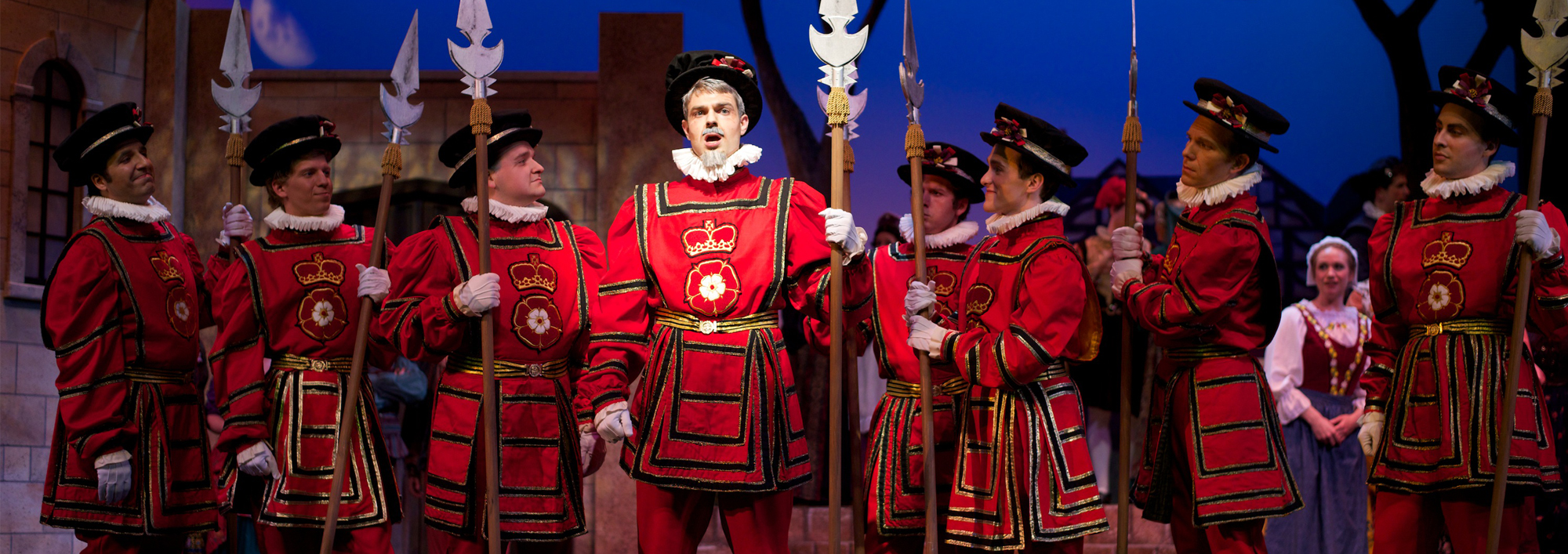
In its combination of comedy and pathos, and the human, rather than farcical, qualities of its characters, The Yeomen of the Guard holds a unique place among the Gilbert and Sullivan operettas. In an inheritance scam by a scheming relative, the bearded Colonel Fairfax has been condemned to death and is to be executed at the Tower of London. Sergeant Meryll, of the Yeomen of the Guard, concocts a plan whereby his son Leonard, arriving to join the Yeomen, will go into hiding and be impersonated by a beardless, unrecognizable Fairfax, thus providing time to seek a pardon. In order to thwart his unscrupulous kinsman, Fairfax begs the Tower Lieutenant to find him a wife. Meanwhile, jester Jack Point and his intended bride, the strolling singer Elsie Maynard, have arrived in town. The Lieutenant confronts Elsie and, with the promise of 100 crowns and an assurance to Jack that her new husband will soon be dead, Elsie is blindfolded, whisked away, and married to Fairfax. But the plan goes awry…. Both Gilbert and Sullivan felt that Yeomen was their finest collaboration. There are few, if any, songs in the operetta repertoire as sincere and emotionally grabbing as Jack and Elsie’s “I Have a Song to Sing, O!”
THE RED MILL
(1906)
Music by Victor Herbert
Libretto by Henry Blossom
Historical reconstruction by Steven Daigle
In none of his 44 produced musical theater works did Victor Herbert kick it into melodic high gear as engagingly as in The Red Mill. Billed as a musical comedy, but with the composer’s expected romantic operetta elements, the storyline centers on two penniless Americans, Kid Conner and Con Kidder, who find themselves stranded in the Dutch port town of Katwyk-aan-Zee. They become entwined in the romance between the Burgomaster’s daughter Gretchen and sailor Captain Van Damm. When they try to help the couple elope, the Burgomaster—who is pushing to wed Gretchen to the governor of Zeeland—gets wind of the scheme and locks his daughter in the local, and reputedly haunted, windmill. Through some clever windmill antics, Kid and Con help Gretchen escape. Her father—needing his now-missing daughter for the imminent wedding—sends away for the best sleuth he knows: Sherlock Holmes. Kid and Con waste no time in assuming the identities of Holmes and Dr. Watson. The wedding eventually takes place, but with a surprise or two. Song hits abound: “Moonbeams,” “Every Day Is Ladies’ Day with Me,” “Because You’re You,” “The Isle of Our Dreams,” and “The Streets of New York.”